Monday, 23 April 2012

Our filming timetable


mood board

We have developed a mood board where we show the themes of our film. The main themes of our film are kidnap, torture, death and violence. My group have picked these due to the themes relating to horror. Our mood board shows our film will be horror as we see gravestones with two ghosts hovering over which suggests that our film will involve the supernatural and include death as gravestones represent death. Next to the graves we see two men scrapping in a brawl which suggests violence will play a part in our film and that we aim to give the feel of an adrenaline rush throughout our film. We also show various characters in masks which means that our film will have some representation of evil in a mask as to show that the film will be about killers aswell as supernatural beings. The blood that is drawn throughout our mood board shows that our film will be gruesome and that violence will play a key part in our film. The writing we have put across our mood board connotes what will happen in our film and suggests that there will be murders and killers on the loose.

preliminary research draft


this is our preliminary research task where we had to film. The filming was done by Ehsham Javed, Farhan Mohammed, Kallam Hussain and Kashif Zaman. Only Farhan and Kallam did the acting and during the beginning there was a problem with some shots missing which meant that the entire scene had to be redone. This was the only problem we had the first time but after we had made this mistake then we decided to start a new script in order for more dialogue to be used as there wasn't enough on our first script. The end result was that our script helped our new film to look much better and overall more entertaining than the first script we made and we practiced different camera angles and shots in our first take which meant for the second take we knew which angles and shots to go with.

Preliminary research task

Film Editing

In film, editing is very important as it can make you edit a film in any way you want such as cutting out things that you don't want in your film and adding sequences together to make a series of events that you shot in a week, look like it all happened in a day. Editing can be a whole range of things such as slowing down set movements which makes things appear in slow-motion or adding special effects such as the title or writing on the screen and explosions and computer generated image ( CGI ) where you can add anything in your film through a computer. People who edit are called editors and they are mainly used to edit films such as cutting clips and adding images and then putting sequences together to make a film.

This is one of the older black and white films and is an example of bad editing as you can clearly see when the shot ends and then the screen blacks out before going to a new shot and this will slow down the story and keep the film boring.


Continuity Editing

Continuity Editing is a style of film editing and video editing used in the post-production of filmaking. The reason continuity editing is used is so that the discontinuity can be smoothed over and to edit shots together to make a sequence of events happen straight after each other and to get footage which was shot in a week and fit it into a few minutes of film. Continuity editing helps the film to flow through sequences and events and this keeps the audience engaged with the story and understand what is happening in the film. Editors put clips together to make a film and so when watching one clip, it smoothes into the next clip without pause so the audience understand what is going on in the film and can follow the sequence of events. Continuity editing is important in filmaking and good for the story and plot as it doesn't get confusing plus in modern film you cannot notice the changes when a clip cuts into the next. With continuity editing you can suggest to the audience that the camera simply changes angles during a single event when really its a series of different shots. Also match on action is when something happens in the scene and when there is a cut then this shows to the audience that the action is still going on and is an important part in helping the audience to keep up and understand what is happening. This is an example of continuity editing.
Continuaty editing is divided up into two categories:

Temporal editing

This is when you connect shots together in order to create and support a narrative so the audience will not get confused with the plot of the film and to keep the flow going between shots. The shots can be linear in order to create a simple linear progression in a film or can include flashbacks or flash forwards to show the audience that a significant amount of time has passed from one shot to the next and also can improve on the narrative by showing what has happened in the past or what will happen in the future in a films narrative.

Spatial editing
This editing creates unified space through the editing. shots from different angles & framing. Shot / reverse shots. also kuleshove effect this also includes something known as parrelel editing.
180 degree rule


this is when you are filming a shot and the camera is on one side. an example of this is if there are two people on stage so the camera can only be on one side of the 180 degree rule as to make it seem more realistic.

Reverse shot


this is a shot where the camera is placed behind a character who is looking off screen at another character and then the camera is placed behind the second character as if to show the second character is looking back at the first. This technique is used to show that the characters are looking in opposite directions at each other and this shows the audience that the two characters are facing each other.

Filmography: homicide ( television series )
year: 1949
http://www.imdb.com/title/tt0041482/

Filmography: great train robbery
year: 1903
http://www.imdb.com/title/tt0000439/

Tuesday, 6 March 2012

Developed treatment

Setting
The main setting for our film is going to be the park where Kallam goes to spend time alone by himself and where he can escape the torment which he suffers from the bullies. The park has many different areas, mainly we chose to film at first the swings during the daytime to show Kallam where he feels most comfortable and then the second area being covered in more trees and isolated from the rest of the park which creates tension and gives a sense of danger as it is an secluded area and is also unfamiliar to Kallam which will make him feel uncomfortable and also due to there being more trees in the secluded area, there is less light which gives it an eerie feeling.

Protagonist and antagonist
The protagonist for our film is a weak, geeky sixth former who is bullied which will cause the audience to sympathize with him and also relate to as many people have been bullied in their lives. Throughout the film, the protagonist will be bullied more and more until he is killed and then comes back to life and decides to exact revenge on his tormentors which will cause the audience to like him more as he stands up to the bullies and takes revenge. By the end of the film the protagonist will be an opposition of how he was at the beginning as he becomes the tormentor rather than the tormented.
The antagonists for our film will be three bullies who stick together and torment peoples lives simply out of the pleasure of seeing other people suffer and to make other people feel bad for their own insecurities. They will show their behavior and personality through their actions to intimidate and physically harm their victims. They usually dress in dark clothing to reflect their personalities. 

Three act structure

1. The setup : the set up for our film is, Kallam the protagonist arrives to college and wants to do his work and try to ignore the bullies who constantly harass him. 
2. The setback : Kallam is on the swings at the park where he is free from his tormentors but the antagonists find him and then beat him up and nearly kill him. Then they find him another day and beat him again in a secluded area of the park and kill him for good.
3. The resolution : The protagonist rises from the dead and dons a new identity which he uses to exact revenge on his tormentors and kill them.

Theory :
Binary opposition - The binary opposition we have chosen for our film is weak vs strong and the reason we have chosen this is to show the everyday struggle between weaker people such as victims of bullying and the stronger people who are the bullies. This is a good opposite mainly because the audience can relate to the struggle between the weak and the strong and how the weak can triumph and become the strong through acts of forceful revenge and motivation.

Character type :
In our film the protagonist will be believable to the audience as he will be a victim of bullying which will also cause the audience to feel sympathy for him and want him to take revenge on the bullies and as bullying is a part of most peoples lives, the audience will be able to relate more to him and understand how his feeling throughout the film. The protagonist will soon be killed by his bullies but return to life in order to exact revenge and will then become an anti-hero as he kills the bullies in violent ways and shows no sympathy towards them, the same way they showed none towards him and he will then reflect how the bullies made his life hell but now he is making their lives hell and he will portray conventions of the horror film genre as he will wear a grotesque mask while killing his tormentors in order to show that he has a new identity as a murderer. The antagonists will consist of:
Ehsham - He is the biggest of the three bullies and the most physically intimidating due to size and stature yet is only the wing-man in the group. He likes to verbally taunt the protagonist with insults in order to impress others around him.
Farhan - He is the leader of the group even though he is the smallest in size and he mainly uses mind games to get what he wants from people. The other bullies are afraid of him due to his aggression and fearfulness and is the bully who beats up the protagonist to near death.
Kashif - He is the outcast among the bullies as he goes along with them just so he can fit in with a group. He is the weakest of the three and is the only bully who wants to change his ways and doesn't have any resentment towards the protagonist.

Equilibrium theory

Equilibrium - the protagonist arrives to college and proceeds to do his work as he usually does and gets verbally taunted by the antagonists.
Disequilibrium - The antagonist start physically attacking the protagonist and eventually kill him
New state of equilibrium - Kallam comes back to life in order to exact revenge on the antagonists.

Monday, 12 December 2011

Preliminary Research

In our preliminary research task my group consisting of me (Ehsham), Kashif, Kallam and Farhan. We had to finish off our storyboards which were fairly simple as most of the storyboards were done already. A problem we had was that we confused a set of sequences on a storyboard so had to redo our storyboard from scratch and also we didn’t have our resources such as crayons so we had to wait whilst someone went to collect the crayons. Also at the beginning of the lesson the computers were not turning on which we had to call the technician in to fix it which he did. We also added more dialogue in our new script as there wasn’t enough in the older script which gives more insight into what is happening in the plot and makes it more detailed.


This is how a big prodcution film studio like pixar use storyboards effectively for their films and they use storyboards to essentially plan out the film. They are different from scripts as they depict how scenes will be played out and what angles and camera shots shall be used in the film.


Filmography - 
Finding nemo (2003)


Monday, 5 December 2011

Primary Research Task

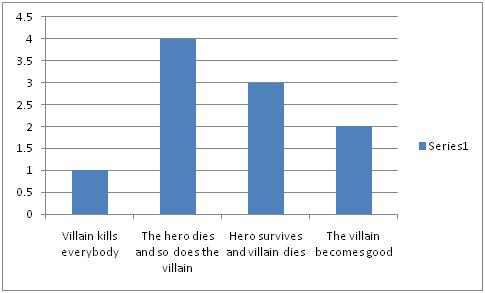
what kind of killer scares you in a horror?
what setting is the scariest?

what sub-genres do you like combined with horror?

which serial killer do you prefer?

does blood make a horror more scary?

what age group are you?

what do you believe is the scariest thing of a horror?

what gender are you?

what do you expect to happen in a horror film?

do you like horror films?